
How to Say Thank You in 20 Languages
“Thank you” is one of the first things worth learning in any language, and one of the most searched. Here it is in 20 languages, with the pronunciation in English letters for the ones written in another script. The chart is free to save and share.
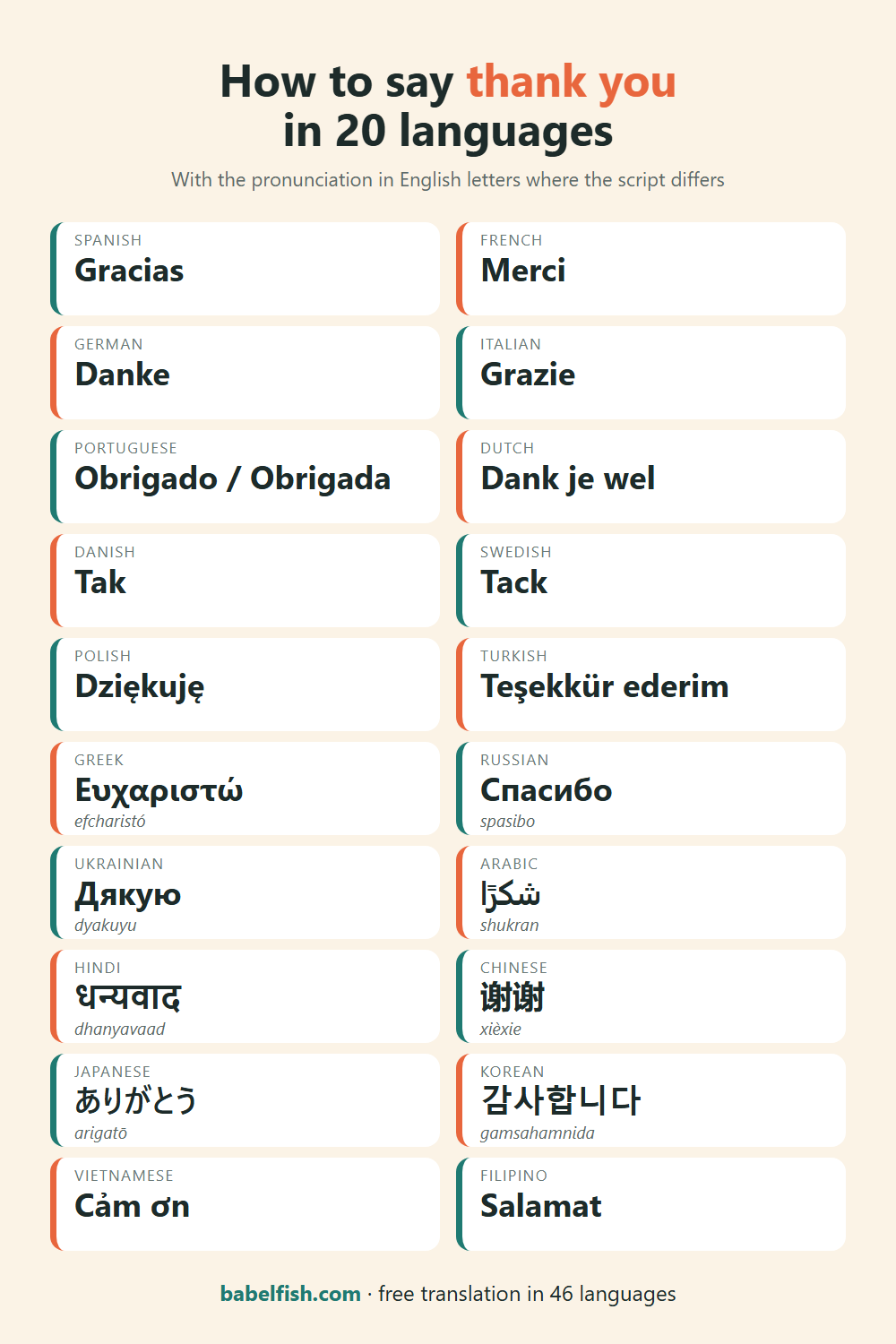
The full list
| Language | Thank you | Pronunciation |
|---|---|---|
| Spanish | Gracias | |
| French | Merci | |
| German | Danke | |
| Italian | Grazie | |
| Portuguese | Obrigado / Obrigada | |
| Dutch | Dank je wel | |
| Danish | Tak | |
| Swedish | Tack | |
| Polish | Dziękuję | |
| Turkish | Teşekkür ederim | |
| Greek | Ευχαριστώ | efcharistó |
| Russian | Спасибо | spasibo |
| Ukrainian | Дякую | dyakuyu |
| Arabic | شكرًا | shukran |
| Hindi | धन्यवाद | dhanyavaad |
| Chinese | 谢谢 | xièxie |
| Japanese | ありがとう | arigatō |
| Korean | 감사합니다 | gamsahamnida |
| Vietnamese | Cảm ơn | |
| Filipino | Salamat |
Languages with a link have their own page, covering the formal and informal forms, how to reply, and example sentences.
A few things a word list will not tell you
- Portuguese changes with the speaker, not the listener: a man says obrigado, a woman says obrigada.
- French merci on its own, in answer to an offer, often means “no, thank you.” German danke works the same way.
- Japanese and Korean build politeness into the word. ありがとう is casual; ありがとうございます (arigatō gozaimasu) is the polite form. 감사합니다 is already polite; friends say 고마워 (gomawo).
- Hindi धन्यवाद is formal. In everyday speech many people say शुक्रिया (shukriya) or simply “thank you” in English.
- Arabic شكرًا (shukran) is understood everywhere Arabic is spoken.
For any other language, or a whole sentence, use the free translator: 46 languages, no sign-up.