
How Neural Machine Translation Works, and Why It's Changed Everything
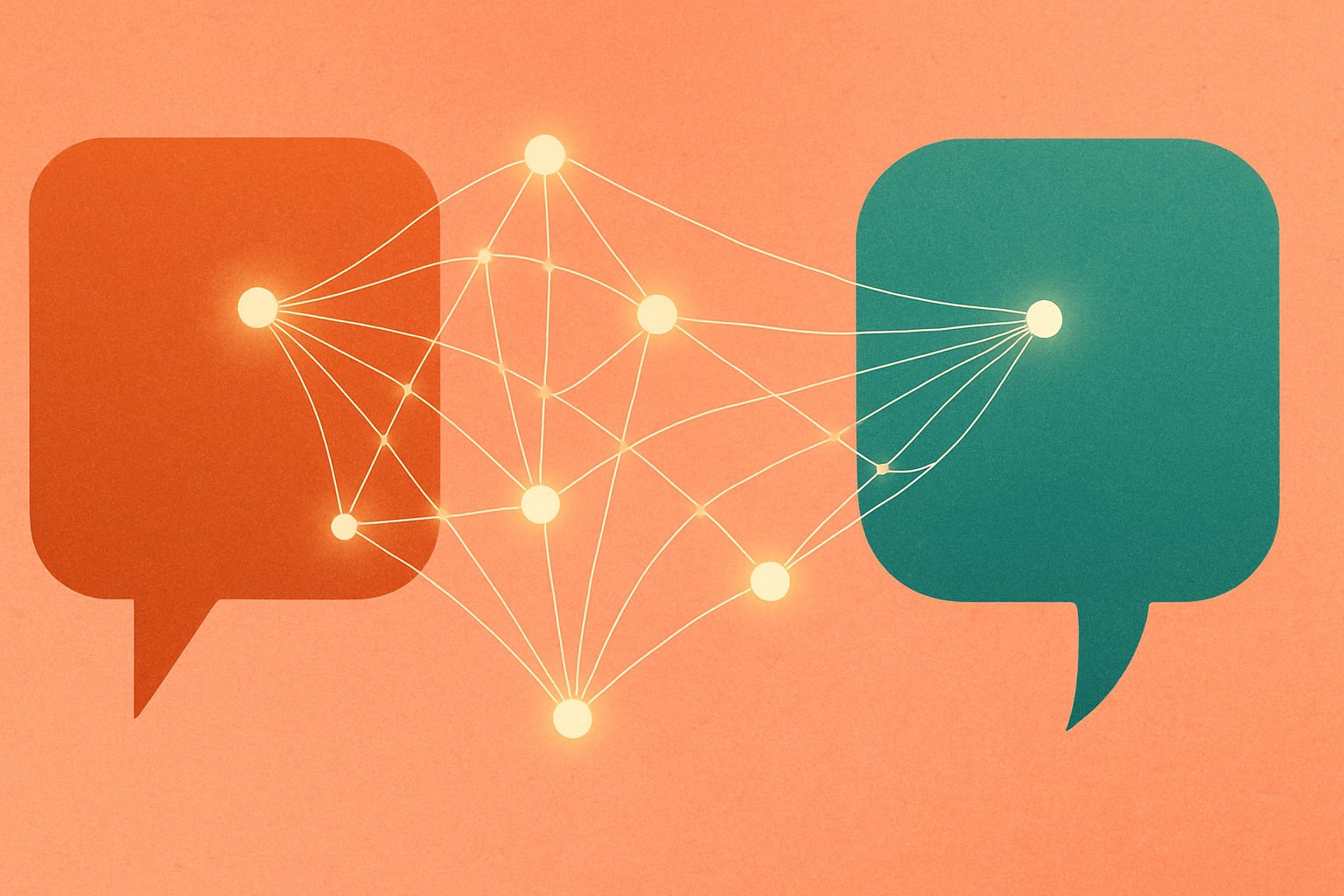
If you used an online translator in 2010, you probably remember the results: technically readable, occasionally amusing, but rarely something you would show to a client or submit to a publisher. Translation technology has changed dramatically since then, and the reason is neural machine translation.
Today's translation tools, including Babelfish, Google Translate, and DeepL, produce output that can pass as human-written on routine text. That is not magic. It is the product of a specific architectural shift in how machines model language. Understanding that shift helps explain both the impressive capabilities and the persistent limitations of every AI translation tool you use.
A Brief History of Machine Translation
Machine translation has been a goal of computer scientists almost as long as computers have existed. The first notable system, Georgetown-IBM, demonstrated English-to-Russian translation in 1954 and predicted that the problem would be fully solved within three to five years. It was not.
Rule-Based Machine Translation (RBMT): 1950s to 1990s
Early systems were built on explicit linguistic rules written by human experts. Linguists encoded grammar rules, dictionaries, and transformation patterns into the software. The machine applied these rules mechanically to convert input text to output text.
The limitation was obvious: natural language is full of exceptions, ambiguities, and context-dependence that rules cannot fully capture. Maintaining rule sets for dozens of language pairs was also prohibitively expensive. The famous early web translators of the late 1990s — including the original Babel Fish service that gave online translation its name — ran on rule-based engines: remarkable for their time, but ultimately constrained by these same fundamental limitations.
Statistical Machine Translation (SMT): 1990s to 2010s
The statistical revolution bypassed the problem of writing rules by learning from data. SMT systems analysed enormous bilingual text corpora, millions of paired sentences in two languages, and learned statistical relationships between them. Given an input sentence, the system predicted the most probable output translation based on observed patterns.
This worked substantially better than rule-based systems for common language pairs with large corpora. But SMT processed text in relatively small chunks (phrases or short spans), and it struggled with long-range dependencies, situations where a word at the end of a sentence changes the meaning of a word at the beginning.
Neural Machine Translation (NMT): 2014 to Present
The breakthrough came with the application of deep neural networks to translation. The key paper, "Attention Is All You Need" (Vaswani et al., 2017), introduced the transformer architecture, the same foundational architecture now used in large language models like GPT and Claude.
NMT systems process entire sentences (and even paragraphs) as unified contexts rather than breaking them into fragments. This allows the model to capture relationships between distant words, handle ambiguity using surrounding context, and produce output that flows much more naturally.
How a Neural Translation Model Works
You do not need a machine learning background to understand the core mechanics.
1. Tokenisation
The input text is broken into tokens, typically words or subword units (common word fragments). The word "untranslatable" might become the tokens [un], [translat], [able]. This allows the model to handle words it has never seen before by recognising familiar components.
2. Encoding
The tokens are converted into numerical vectors, lists of numbers that represent their meaning. Crucially, these vectors encode not just the word itself but its position in the sentence and its relationship to surrounding words. A transformer model processes all tokens simultaneously (unlike older recurrent networks that processed them one at a time), allowing it to build a rich, context-aware representation of the entire input.
3. Attention Mechanism
The attention mechanism is what makes transformers powerful. When generating each word of the output, the model "attends" to different parts of the input with varying weights, effectively deciding which input tokens are most relevant for producing the current output token.
For example, when translating the French "Elle a mangé la tarte qu'il avait préparée" to English, when the model reaches the word "prepared," it needs to attend back to "il" (he) to get the gender agreement right. An attention mechanism makes this explicit and trainable.
4. Decoding
The decoder generates the output translation token by token, each time attending to both the encoded input and the tokens it has already generated. This auto-regressive process continues until the model produces an end-of-sequence token.
5. Training
The model is trained on massive bilingual datasets, billions of sentence pairs. During training, it generates a translation, compares it to the known correct translation, and adjusts its internal parameters to reduce the error. With enough data and compute, the model learns to capture grammar, idiom, register, and style across language pairs.
Where NMT Excels
Modern NMT systems are genuinely impressive for:
- Common language pairs with abundant training data: English ↔ Spanish, French, German, Chinese, Japanese, Arabic. Output is often fluent enough for publication after light editing.
- Routine business and general content: emails, product descriptions, news articles, and documentation.
- Long sentences with complex dependencies: the transformer's ability to model long-range context is a genuine advantage over SMT here.
- Speed: a neural model can translate a document of thousands of words in seconds.
Where NMT Still Fails
Despite the leaps in quality, NMT has consistent failure modes that every user should understand:
Idiomatic language
Phrases whose meaning is not derivable from their literal words routinely trip up NMT systems. "Kick the bucket," "pull someone's leg," "break a leg"; these are well-known idioms in high-resource languages, and models have often seen enough examples to handle them. But rare idioms, slang, and colloquialisms still produce literal, nonsensical translations.
Low-resource languages
NMT quality is directly correlated with training data volume. Languages with few digitised texts, many African, Central Asian, and Pacific languages, produce significantly worse results than high-resource languages. The model simply has not seen enough examples to learn the patterns reliably.
Ambiguity without context
The word "bank" in English can refer to a financial institution or a riverbank. Without surrounding context that makes the meaning clear, NMT systems sometimes choose incorrectly. Models have improved at using sentence-level context, but document-level ambiguity remains a challenge.
Highly technical or specialised content
Medical, legal, and engineering texts contain terminology where a single mistranslated word can change the meaning of a sentence in consequential ways. General-purpose translation models are not trained on specialist corpora and should not be trusted for high-stakes professional translation without expert review.
Hallucination
Like all neural language models, NMT systems can occasionally generate fluent-sounding output that is simply wrong, a translated sentence that looks correct but omits or adds information not present in the source. This is rare with dedicated translation models but worth being aware of.
What This Means for How You Use Translation Tools
Understanding NMT's capabilities and limits leads to a straightforward practical framework:
Trust machine translation for: - Internal communications and getting-the-gist comprehension - Drafts of routine content in well-supported language pairs, to be reviewed by a native speaker - Translating large volumes of product data, descriptions, or structured content where perfect fluency is less critical
Do not trust machine translation for: - Legal documents, contracts, or compliance materials - Medical or clinical content - Marketing copy where tone, personality, and cultural resonance matter - Languages with limited training data where quality is inherently lower
The best approach for most professional use cases is machine translation with human post-editing (MTPE): use a quality NMT tool to generate a first draft, then have a qualified human translator review and refine it. This produces near-human-quality output at a fraction of the time and cost of pure human translation.
The Road Ahead
NMT research is moving quickly. Current directions include:
- Document-level translation: models that consider the full document context rather than sentence-by-sentence, reducing inconsistency and improving long-document coherence
- Multilingual models: single models trained on dozens of language pairs simultaneously, which has shown cross-lingual transfer benefits for low-resource languages
- Multimodal translation: incorporating images, audio, and video alongside text to resolve ambiguity and improve contextual accuracy
- Domain adaptation: fine-tuned models trained on specialised corpora for medical, legal, or technical content
The gap between machine and human translation continues to narrow. For most everyday use cases in well-supported languages, that gap has become narrow enough to make high-quality machine translation a practical default, provided users understand its limits and apply human judgment where it matters.
Babelfish is one of the web's longest-running translators, instant translation between 46 languages, free and with no sign-up, plus an archive of phrases answered by real speakers. Try it here.